Central African Republic
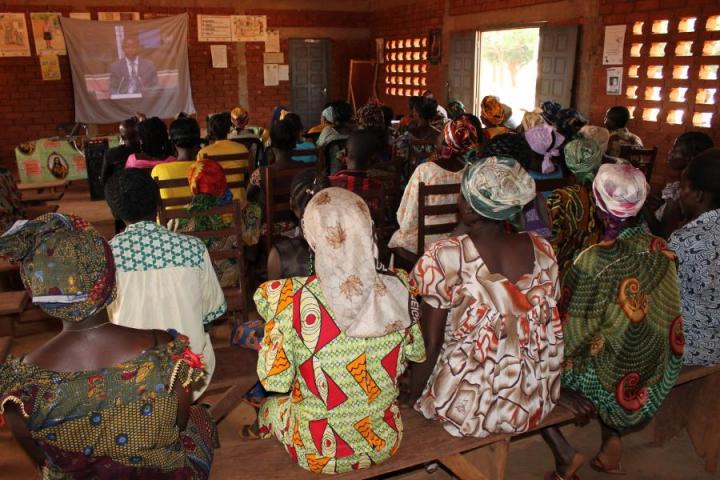
“Before the 2003 violence, I supported my family through seasonal work. The violence took that away, and life became very hard. In 2021, I joined a TFV-supported programme where I accessed psychosocial support and the tools to start my own business. With these, I rebuilt my livelihood and found stability again. My children went back to school, and today one of them proudly serves as a police officer.” – Paulette, survivor and programme participant, Central African Republic
At a glance
|
Status |
Ongoing |
|
Programme period |
Pilot from September 2020; full programme since February 2021 |
|
Where |
27 locations in 6 provinces, including Bangui |
|
Who it serves |
Survivors of conflict-related sexual violence and their families |
|
People reached |
14,982 beneficiaries since 2020, as at 30 June 2026 |
|
|
Background
Based on referrals made by the authorities of the Central African Republic (CAR) in 2004 and 2014, the International Criminal Court (ICC) has jurisdiction throughout the territory of CAR in relation to crimes against humanity and war crimes committed:
- in the context of the peak of violence in 2002 and 2003, with a focus on sexual violence (“ICC Situation in CAR I”); and
- in the context of renewed violence since 1 August 2012, in the Seleka and Anti-Balaka conflict (“ICC Situation in CAR II”).
The programme
In parallel to the judicial activities of the ICC, the Trust Fund for Victims (TFV) has a mandate to provide assistance that redresses the impact of crimes under the jurisdiction of the Court. On the basis of this mandate, the TFV has run a holistic programme for the benefit of victims of conflict-related sexual violence since 2020.
Conflict-related sexual violence affects the physical and mental health of victims. The deterioration of their health results in stigma and marginalisation, which in turn worsen socio-economic challenges. Many survivors, as well as children born of rape, live with HIV/AIDS and face significant barriers in accessing medication, nutritional support and healthcare. Displaced survivors in Bangui lack safe shelter, which hinders their dignity and their ability to find work. Children born of rape often face stigma, limited access to education and difficulties in obtaining birth certificates.
Looking ahead (2025–2027)
- The Board of Directors has approved the continuation of the programme for the contractual year 2025–2026.
- The TFV seeks to mobilise EUR 3 million to continue the programme beyond 2026.
- The TFV is preparing for potential reparations stemming from two cases under judicial proceedings at the ICC, which concern at least 5,000 victims, including former child soldiers.
- The TFV is sharing experience on reparative approaches with the Special Criminal Court for CAR (CPS) and transitional justice mechanisms in CAR.
Who the programme is for
People the programme works with directly:
- Female and male survivors of conflict-related sexual violence committed in CAR within the jurisdiction of the ICC.
People who benefit more widely:
- Indirect victims, namely children born of rape and the partners and family members of direct victims.
What the programme delivers
The programme provides interventions with both short- and long-term impact through five lines of action:
- Medical support
- Psychological and psychosocial support
- Specialised support to children born of rape
- Socio-economic resilience
- Targeted positive masculinity approaches
Positive masculinities. Despite the positive impact of holistic services, female survivors often continue to suffer gender-based violence from domestic partners and other relatives. The TFV therefore applies a gender-transformative approach focused primarily on men, based on the “Journey of Transformation” training. It builds communication, problem-solving and self-management skills to improve relationships between couples and within families, even where participants are illiterate. The approach has reduced drug and alcohol consumption, increased men’s participation in child-rearing and domestic tasks, and reduced violence.
Impact and sustainability
- Beneficiaries report restored mental health and psychosocial well-being, with stabilised health status and improved physical condition.
- Beneficiaries report independent income from successful businesses.
- Education support for children born of rape has reduced the risks of juvenile delinquency, sexual abuse and other violations of children’s rights.
- Between 2021 and 2023, 80.16 per cent of participating couples (566 of 706) reported a drastic change in their relationships and a considerable reduction in domestic violence.
- Social workers trained in psychosocial techniques and positive masculinity replicate the programme’s impact and guarantee continued local impact.
Funding
Since 2004, 53 States Parties have contributed at least once to the TFV, for a total of EUR 56 million. Because of the nature of its interventions, contributions to the TFV are ODA-eligible and may be earmarked to a specific country, type of victim or type of activity.
The programme is designed and managed by the Secretariat of the TFV under the supervision of the Board of Directors. The Secretariat is funded from the regular contributions of States Parties, so there are no overheads on the programme and resources go entirely to victims.
Last Update: September 2026