The Al Mahdi Case
Background
Between 30 June and 11 July 2012, while Timbuktu was under the control of armed groups affiliated with al-Qaeda, Mr Al Faqi Al Mahdi organised and took part in attacks on ten of the most important sites, including the mausoleums of Timbuktu's saints and the Sidi Yahia Mosque. The mausoleums had long been places of pilgrimage and considered to spiritually protect the city. Timbuktu was inscribed on the UNESCO World Heritage List in 1988 for its role in the spread of Islam in Africa and as a historic centre of learning.
In its judgment, the Court found that the destruction harmed not only the inhabitants of Timbuktu but Malians and the international community as a whole, because cultural heritage of this kind belongs to all of humanity. The case established that attacking such heritage can itself be prosecuted as a war crime.
The ten protected sites: seven standalone mausoleums:
- Sidi Mahamoud Ben Omar Mohamed Aquit;
- Sheikh Mohamed Mahmoud Al Arawani;
- Sheikh Sidi El Mokhtar Ben Sidi Mouhammad Al Kabir Al Kounti;
- Alpha Moya;
- Sheikh Mouhamad El Mikki;
- Sheikh Abdoul Kassim Attouaty;
- Sheikh Sidi Ahmed Ben Amar Arragadi,
- The two mausoleums adjoining the Djingareyber Mosque (Ahmed Fulane and Bahaber Babadié), and the door of the Sidi Yahia Mosque.
In 2016, the ICC convicted Ahmad Al Faqi Al Mahdi of the war crime of intentionally directing attacks against historic and religious monuments in Timbuktu in 2012, and sentenced him to nine years' imprisonment. On 25 November 2021, Mr Al Mahdi's imprisonment sentence was reduced by two years.
On 17 August 2017, ICC Trial Chamber VIII issued a Reparations Order setting Mr Al Mahdi's liability at €2.7 million to address the harm caused to the affected community, including the destruction of protected cultural heritage. The Order provided for symbolic, individual and collective measures, encompassing financial awards, the restoration of cultural sites, memorialisation, psychosocial support and economic recovery.
Mr Al Mahdi was indigent. The Chamber invited the TFV to raise and complement the liability, as well as to undertake the implementation of the reparations, following confirmation of the Order by the Appeals Chamber on 8 March 2018, drawing on contributions from States Parties and other donors.
As of 31 March 2026, the TFV has implemented the reparations programme in accordance with the Reparations Order. This completion was formally communicated to the respective Trial Chamber on 29 April 2026 and to the Government of Mali on 6 May 2026.
The programme was delivered in close coordination with the Government of Mali and regional authorities through dedicated steering committees, ensuring strong national ownership and sustained engagement with victims and affected communities.
Some key achievements include:
- Erection of the Louha and Qâloum memorials.
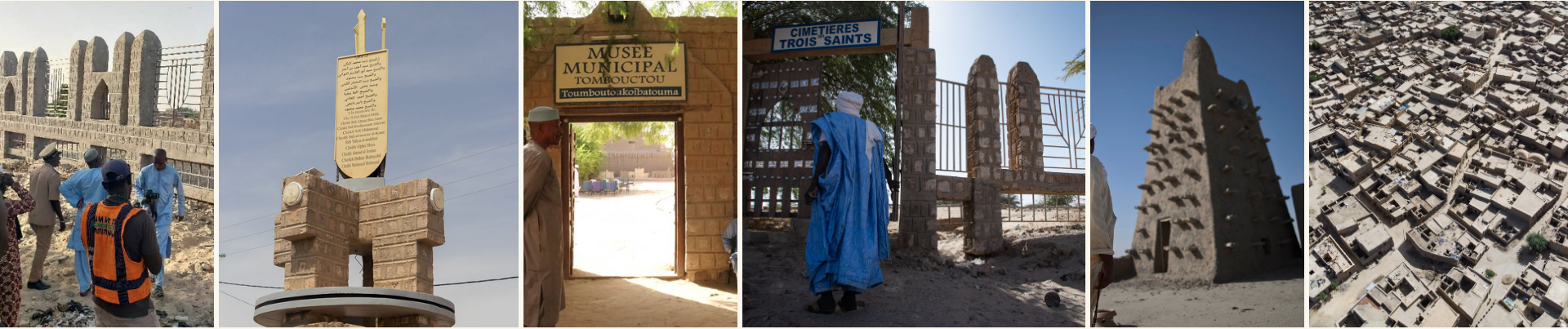
- Establishment of a permanent exhibition on protected buildings at the Timbuktu Municipal Museum, which was rehabilitated and extended.
- Support to 70 local initiatives across the community and three macro-projects.
- Completion of protective infrastructure and heritage preservation measures.
- Co-organisation, with the Government of Mali, of a high-level ceremony held under the presidency of His Excellency Mr Bah N'Daw, then President of the Transition and Head of State of Mali.
Reach and beneficiaries - Over 70,000 members of the local communities of Timbuktu benefited from collective measures focused on cultural heritage restoration, memorialisation, psychological support and economic resilience.
- Of the 1,691 victims reached, 1,687 were eligible and received individual awards — economic compensation for those whose livelihoods depended exclusively on the sites, and symbolic payments for descendants.
The individual component was implemented directly by the TFV in collaboration with intermediaries and the Legal Representative of the Victims. The collective component was delivered in partnership with UNESCO, the CIDEAL Foundation and CFOGRAD, whose sustained work over the past five years was instrumental to the programme's success.
- A gender-sensitive approach: a strong gender-sensitive approach was integrated throughout the programme through a dedicated Gender Action Plan.
- Victim participation: victim participation remained the bedrock of the programme. Wide-ranging consultations across Timbuktu's communities ensured that reparations were shaped by those directly affected, reinforcing inclusivity, transparency and local ownership throughout implementation.
- Funding: the reparations delivered were made possible by earmarked contributions from the governments of Canada, Germany, Italy, Norway, and the United Kingdom. Unrestricted contributions from the Czech Republic, Dominican Republic, Liechtenstein, and other supporters were allocated by the Board of Directors to this case. Assessed contributions from all States Parties to the ICC Regular Budget enabled the judicial process and essential programmatic components, including staffing, travel, and operational support.
How it worked
The Court set the liability and the broad categories of harm; the TFV then designed and delivered the actual measures on the ground, always shaped by consultations with the affected community:
|
Type
|
Finished
|
What it delivered
|
|
Symbolic
|
2021
|
On 30 March 2021, a solemn ceremony publicly acknowledged the harm caused.
|
|
Individual
|
2024
|
In 2024, individual awards were made to 1,687 eligible victims — economic compensation for those whose livelihoods depended exclusively on the sites, and symbolic payments for descendants.
|
|
Collective
|
2026
|
Launched in July 2022 and completed by 31 March 2026 — heritage restoration, memorials, psychological support and economic recovery.
|
Individual awards were delivered by the TFV with intermediaries and the Legal Representative of Victims; collective measures with UNESCO, the CIDEAL Foundation and CFOGRAD over five years.
Field activities, with examples
SYMBOLIC — acknowledgement and memory
- Solemn ceremony: a symbolic ceremony was held on 30 March 2021, organised with the State of Mali and UNESCO, on behalf of the Malian people and the international community.
- Memorials: two memorials were built in Timbuktu — the Louha, inaugurated in October 2024, and the Qâloum, inaugurated in February 2025. Named after the Koranic tablet (“louha”) and the pen used to write upon it (“qâloum”), the memorials symbolise the resilience and memory of the Timbuktu community and its centuries-old tradition of learning.
- Apology: Mr Al Mahdi's in-court apology — which the judges found genuine and empathetic — was made available to victims in their own languages
INDIVIDUAL — awards to specific eligible victims - Eligible victims: people whose livelihoods depended exclusively on the sites, and descendants whose ancestors' burial sites were damaged.
- Individual awards: out of the 1,691 victims reached, 1,687 were eligible and received individual awards, identified through a TFV administrative screening — economic compensation for those whose livelihoods depended exclusively on the sites, and symbolic payments for descendants.
COLLECTIVE — measures for the whole community
In total, 42 major community-based measures were delivered between July 2022 and 31 March 2026, benefiting more than 70,000 members of the Timbuktu community, organised around three modalities: moral harm, economic harm, and the protection and maintenance of the protected buildings.
- Heritage restoration & protection: reconstruction of the Sheikh Mohamed Mahmoud Al Arawani mausoleum, handed over to the Saint's descendants in October 2024; rehabilitation of the enclosure walls, gates and doors of the Three Saints and Alpha Moya cemeteries; tree and hedge planting supported by drip irrigation systems across four cemeteries; two solar-powered boreholes at the Sidi Mahamoud and Three Saints cemeteries, supplying water to the sites and surrounding communities; lighting improvements around the protected buildings; ten informational panels and ten plaques installed across the nine mausoleums and the Sidi Yahia Mosque, raising public awareness and gradually reviving tourism; capacity strengthening of the traditional masons' corporation and the Cultural Mission, including a solar energy system and digital equipment; and a Maintenance Fund so the community can keep the sites safe long-term.
- Memory & education: the Timbuktu Municipal Museum was rehabilitated and extended to host a permanent exhibition on the protected buildings, preserving the memory of the destruction for future generations.
- Psychological support: community-based mental-health and rehabilitation measures addressing the moral harm felt across Timbuktu.
- Economic resilience: delivered through the Economic Resilience Facility (ERF), structured around two components — a Microproject Support Fund financing 70 local initiatives (60 in Timbuktu, 10 in Bamako), each up to about EUR 9,900, selected by community selection committees established across eight neighbourhoods of Timbuktu and one in Bamako, such as handicraft workshops and vegetable farming; and three macro-projects conducted with the Municipality of Timbuktu to benefit the entire community, including wastewater management infrastructure and a city-wide sanitation initiative supporting residents in maintaining their urban environment, in particular the protected sites.
The TFV's final report to the Trial Chamber is expected in early 2027.
Two threads running through everything
- A dedicated Gender Action Plan recognised the specific harm to women and their central role in preserving and transmitting heritage and built measures to strengthen their participation in the recovery.
- Wide-ranging participation across Timbuktu shaped the measures throughout, with national ownership secured through steering committees with the Government of Mali and regional authorities.
Resources
1. Press Releases
Ahmad Al Faqi Al Mahdi case: collective reparations are launched upon completion of the individual reparations, 12 July 2022
https://trustfundforvictims.org/index.php/en/news/ahmad-al-faqi-al-mahdi-case-collective-reparations-are-launched-upon-completion-individual
Al Mahdi Case: ICC Trust Fund for Victims Delivers Collective Reparations to Timbuktu Community, 10 October 2024
https://www.icc-cpi.int/news/al-mahdi-case-icc-trust-fund-victims-delivers-collective-reparations-timbuktu-community
ICC Trust Fund for Victims Completes Reparations Programme in Mali in relation to the Al Mahdi Case, 3 July 2026
https://www.icc-cpi.int/news/icc-trust-fund-victims-completes-reparations-programme-mali-relation-al-mahdi-case
2. Video Materials
Programme Overview, October 2024
Al Mahdi Reparations Programme — Update on Implementation: https://www.youtube.com/watch?v=ydRBumUk46k
Beneficiary Testimonies
Mr Modibo — Beneficiary of the Reparations Programme: https://www.youtube.com/watch?v=w48hh-l4fe0
Ms Cissé — Beneficiary of the Reparations Programme: https://www.youtube.com/watch?v=UxbSV2C9_X8
Documentary
Al Walidji — Les Mausolées: https://www.youtube.com/watch?v=Z8gXHHsK7lA
3. Additional Resources
- Map of Collective Reparations Activities in Timbuktu
- Gallery of Photos in English French Spanish Arabic
- Infographic on the Al Mahdi Reparations Programme French, English and Spanish